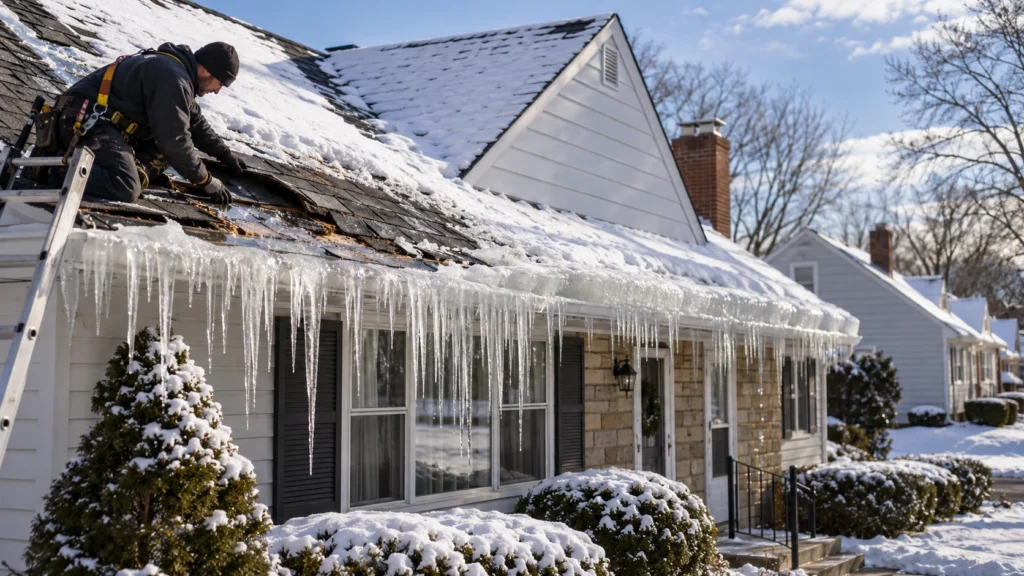
You walk into your living room after a January cold snap and spot a brown stain spreading across the ceiling. Outside, thick icicles hang off the gutters — the kind that almost look pretty until water starts dripping down your interior walls. If you’re a Levittown homeowner dealing with ice dam roof damage this winter, you already know the sinking feeling that comes with it. You’ve probably tried knocking the ice down or running a space heater in the attic, and the leak kept coming back. Here’s the frustrating truth: the ice on your roof is a symptom, not the cause. In my 30 years working with Bucks County homeowners, I’ve found the real problem is almost always hidden inside the roof itself. This article breaks down what actually goes wrong, how to spot it, and how to stop it from happening again.
What You’ll Learn
- What Ice Dam Roof Damage Is and Why It Happens
- The Real Causes Behind Ice Dams
- How to Identify Ice Dam Damage in Your Home
- Solution Options for Levittown and Bucks County Homeowners
- Why Bucks County Homeowners Choose Rylee Ann Roofing
- Frequently Asked Questions
- Next Steps
What Is Ice Dam Roof Damage?
An ice dam is a ridge of ice that forms along the lower edge of your roof and traps melting snow behind it. That trapped water has nowhere to drain, so it backs up under your shingles and finds its way inside. Most people don’t realize the damage is happening until they see the results indoors.
Common warning signs include:
- Thick icicles hanging from the gutters and eaves
- Water stains on ceilings or along the tops of exterior walls
- Peeling paint or damp drywall after a thaw
- Ice building up in the gutters themselves
- Visible ice ridges along the roof edge
This problem shows up most on older Levittown homes with low-slope roofs and original attic setups. Left alone, ice dams rot roof decking, ruin insulation, stain ceilings, and create the damp conditions where mold takes hold. What looks like a winter nuisance can turn into thousands of dollars in structural repairs.
The Real Causes Behind Ice Dams
Here’s what most homeowners get wrong: ice dams aren’t really about the weather. They’re about heat escaping your home. The snow on your roof melts, refreezes at the cold edge, and the cycle repeats. Fix the heat problem, and the ice problem goes away. In our experience across Bucks County, three culprits are almost always at work.
Poor Attic Insulation
When your attic floor doesn’t have enough insulation, heat from your living space rises straight into the attic and warms the underside of the roof. That warmth melts the snow sitting on the upper roof, even when it’s below freezing outside. The meltwater runs down to the eaves — which stay cold because they hang past the heated part of the house — and freezes into a dam. Many Levittown homes were built decades ago with insulation that’s since compressed or degraded, so the attic runs far warmer than it should. If your upstairs rooms are hard to heat, that’s often the same escaping heat showing up as ice outside.
Inadequate Attic Ventilation
A roof needs to breathe. Cold air should flow in through the soffit vents at the eaves and exit through vents near the ridge, keeping the entire roof deck at one even temperature. When that airflow is blocked — by packed insulation, painted-over soffits, or missing ridge vents — warm air gets stuck in the attic and creates hot and cold zones across the roof. Those temperature swings are exactly what drives the melt-and-refreeze cycle. This is the cause people miss most often, because you can’t see ventilation from the ground.
Air Leaks from the Living Space
Gaps around recessed lights, bathroom fans, attic hatches, and plumbing stacks let warm, moist household air pour directly into the attic. This is often the single biggest heat source, and it’s why DIY fixes fail. You can chip away at the ice all winter, but if warm air keeps leaking upward, the dam reforms within days. During our inspections, we regularly find these leaks hiding behind insulation where a homeowner would never think to look.
The reason DIY approaches rarely work is that they treat the ice, not the heat. Chipping ice risks damaging shingles and is dangerous on a slick roof. The dam comes back because the underlying heat loss was never addressed.
How to Identify Ice Dam Damage in Your Home
You can do a safe, ground-level assessment before calling anyone. Here’s what to check:
- Look at your eaves during and after snow. Thick icicles and a visible ice ridge at the roof edge are the clearest sign a dam is forming.
- Check your ceilings and top wall corners. Fresh brown stains, bubbling paint, or soft spots point to water already getting inside.
- Watch how snow melts on your roof. If patches melt fast while the eaves stay iced over, heat is escaping through the roof.
- Feel your upstairs rooms. Rooms that are cold or drafty often signal the insulation and air-sealing problems behind the ice.
- Peek into the attic (carefully). Damp insulation, water marks on the underside of the decking, or daylight around vents all confirm the issue.
If you see active dripping, stained ceilings, or damp attic decking, don’t wait — that’s water already inside your roof system, and it’s time to call a professional roofer.
Solution Options for Levittown and Bucks County Homeowners
What You Can Safely Do Yourself
For minor situations, there are a few safe steps. You can rake fresh snow off the lower three or four feet of roof from the ground with a roof rake, which removes the snow that would otherwise melt and feed the dam. Keeping gutters clean in the fall also helps water drain before it can freeze.
What you should never do: climb onto an icy roof, chip at ice with a hammer or shovel, or run space heaters in the attic. These either damage your roof or put you at serious risk, and none of them fix the cause.
The Professional Solution
Stopping ice dams for good means addressing the heat loss, not just the ice. A proper roofing assessment looks at the whole system — insulation levels, attic ventilation, air leaks, and the condition of your shingles and underlayment. Depending on what we find, the fix may involve adding insulation to the attic floor, correcting soffit-to-ridge ventilation so the roof stays cold and even, sealing air leaks from the living space, and installing an ice-and-water shield membrane along the eaves during a re-roof. That membrane is a self-sealing barrier that stops backed-up water from getting under the shingles even if a dam forms.
Why Professional Roofing Makes Sense
The math favors doing it right. A season of chasing leaks, patching ceilings, and replacing wet insulation costs far more than solving the root cause once. Improper DIY work on a winter roof also risks injury and voided warranties. When Rylee Ann Roofing corrects the underlying heat and ventilation problems, the dam stops forming — and every residential asphalt shingle installation we do is backed by our 10-year leak-free workmanship warranty. That’s peace of mind through every winter that follows.
Why Bucks County Homeowners Choose Rylee Ann Roofing
We’ve spent 30 years diagnosing exactly these kinds of problems on Bucks County roofs, and we understand the local factors that drive them — the freeze-thaw swings, the Nor’easters, and the aging housing stock in communities like Levittown where original attics were never built for today’s standards. Because we’re dedicated solely to roofing rather than being a general construction company, every crew member is a roofing specialist who knows how insulation, ventilation, and shingles work together as one system.
Homeowners across Levittown, Fairless Hills, Yardley, and Newtown trust us because Steve Nickerson is onsite for every job, not a rotating crew of subcontractors. Rylee Ann Roofing is an Owens Corning Certified Installer, licensed in Pennsylvania (HIC #139247) and New Jersey (HIC #13VH10032900), a Nextdoor Neighborhood Favorite for 2022, and holds a 5-star Google rating with 50-plus reviews. We back our work with a 10-year leak-free warranty and a 24-hour issue resolution policy — because standing behind the job is a company standard, not a slogan.
Frequently Asked Questions
How much does ice dam roof repair cost in Bucks County PA? Cost depends on how much damage the water caused and whether the fix involves insulation, ventilation, or a partial re-roof with ice-and-water shield. Every situation is different, which is why we provide a free, no-obligation estimate after inspecting your specific roof and attic.
What causes ice dams on a roof? Ice dams form when heat escaping your home melts snow on the upper roof, and that water refreezes at the cold eaves. The real causes are usually poor attic insulation, blocked ventilation, and warm air leaking up from the living space — not the outdoor temperature alone.
Can I remove an ice dam myself? You can safely rake snow off the lower roof edge from the ground, but you should never climb an icy roof or chip at the ice. Those approaches risk injury and shingle damage, and they don’t stop the dam from returning. The lasting fix addresses the heat loss underneath.
Are ice dams dangerous or urgent? Yes. Once water backs up under your shingles, it can rot decking, soak insulation, stain ceilings, and lead to mold. If you see active dripping or ceiling stains, treat it as urgent and have the roof assessed promptly.
How do I stop ice dams from coming back every winter? The only reliable way is to correct the underlying heat and ventilation issues — adding insulation, sealing attic air leaks, and balancing soffit-to-ridge airflow so the roof stays cold and even. Treating the ice alone guarantees it returns.
When should I call a professional roofer in Levittown? Call as soon as you notice interior water stains, damp attic decking, or repeat ice buildup year after year. These are signs the problem is inside the roof system, where a professional inspection is needed to find and fix the cause.
Next Steps
If ice dams are threatening your Levittown home, here’s what to keep in mind:
- The ice is a symptom — the real problem is heat escaping into your attic
- Insulation, ventilation, and air leaks are almost always the true causes
- DIY ice removal doesn’t fix the cause and can be dangerous
- A proper roofing assessment stops the cycle for good
Don’t wait for the next thaw to find another stain on your ceiling. Call Rylee Ann Roofing at 833-691-7663 or request your free estimate online. We respond within 24 hours, offer a free Roofing Report Card to pinpoint what’s really going on, and serve Bucks County PA, Lehigh County PA, Mercer County NJ, and Burlington County NJ. We’re open Monday through Friday 7am–5pm and Saturday 7am–12pm.
About the Author
Steve Nickerson is the Estimator and Principal at Rylee Ann Roofing, with 30 years of experience in residential and commercial roofing. Specializes in roof system diagnostics, storm damage assessment, and solving the kind of hidden insulation and ventilation problems that cause recurring leaks. Steve is licensed in Pennsylvania and New Jersey, an Owens Corning Certified Installer, and is personally onsite for every job.