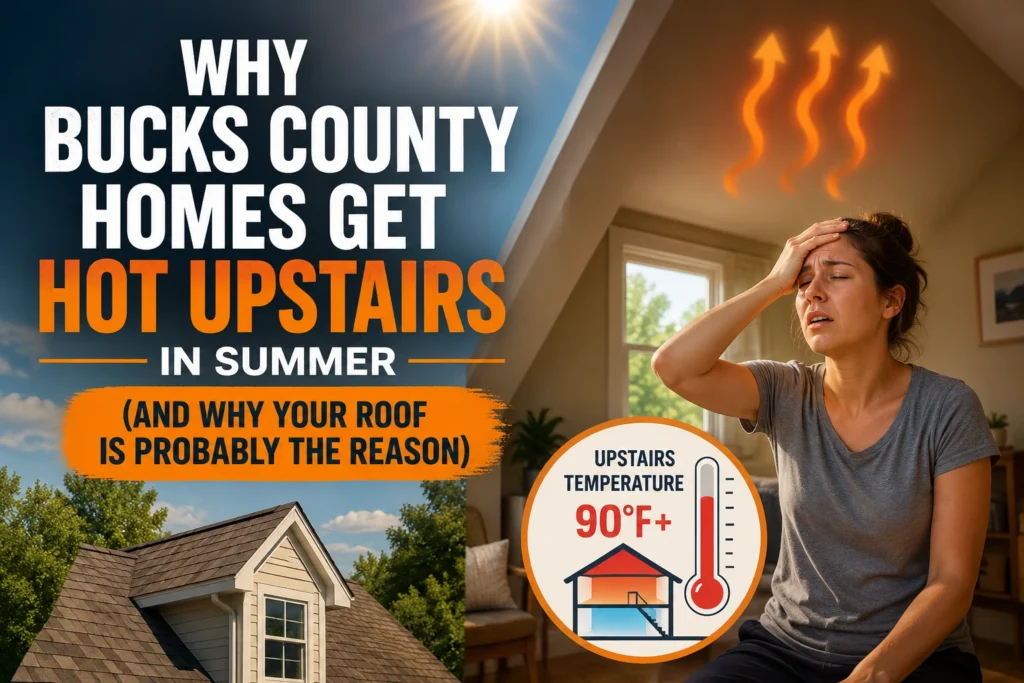
You crank the AC, but the upstairs still feels like an oven by mid-afternoon. The bedrooms are stuffy, the thermostat reads one thing while your second floor feels ten degrees hotter, and your electric bill keeps climbing. If you’re a Bucks County homeowner dealing with this every July, you’re not imagining it — and you’ve probably already tried closing blinds, running fans, or bumping the AC even lower without real relief.
Here’s the part most people miss: the problem usually isn’t your air conditioner. It’s your roof. After 30 years inspecting roofs across Fairless Hills, Levittown, and Yardley, I can tell you that a hot second floor is almost always a roof ventilation problem in disguise. In this article, I’ll walk you through what’s really happening up there and how to fix it for good.
What You’ll Learn
- What Is a Hot Upstairs Problem and Why Does It Happen?
- The Real Causes Behind a Hot Second Floor
- How to Identify a Roof Ventilation Problem in Your Home
- Solution Options for Bucks County Homeowners
- Why Bucks County Homeowners Choose Rylee Ann Roofing
- Frequently Asked Questions
- Next Steps
What Is a Hot Upstairs Problem?
A hot upstairs is exactly what it sounds like: your second floor stays noticeably warmer than your first floor during summer, no matter how hard your AC works. It’s one of the most common complaints I hear from Bucks County homeowners once the humid summer weather rolls in.
Here are the signs you’re dealing with this problem:
- Bedrooms upstairs feel 5 to 15 degrees hotter than downstairs
- The AC runs constantly but the upstairs never cools off
- Your energy bills spike every summer
- Rooms directly under the roof feel like a sauna by afternoon
- The air feels stuffy and stale, not just warm
This usually hits homes in mid to late summer, when our humid Bucks County days pile up and attic temperatures climb. It matters because a hot upstairs isn’t just uncomfortable — it overworks your AC, shortens the life of your system, and quietly bakes your roof from the inside out, which can shorten the life of your shingles.
The Real Causes Behind a Hot Second Floor
Most homeowners blame the AC or the summer heat. But in our experience, the real cause is almost always tied to what’s happening in your attic and roof. Here’s what’s actually going on.
Poor Attic Ventilation
This is the number one culprit I find during inspections. Your attic needs a constant flow of air — cool air coming in at the soffits (the underside of your roof’s edge) and hot air escaping near the ridge (the peak). When that airflow is blocked or never existed, heat gets trapped. On a 90-degree Bucks County day, an under-ventilated attic can hit 140 degrees or more. That trapped heat radiates straight down into your bedrooms. The sign? Your upstairs is hottest in the late afternoon and stays warm long after sunset.
Inadequate or Compressed Insulation
Insulation slows the heat moving from your scorching attic into your living space. In a lot of older Levittown and Fairless Hills homes, the insulation has settled, thinned out, or was never enough to begin with. When it’s compressed or missing in spots, heat pours through your ceiling. If certain rooms are far hotter than others, uneven insulation is often why.
Blocked or Missing Soffit Vents
Ventilation only works when air can get in. I regularly find soffit vents that have been painted over, stuffed with insulation, or blocked by debris. Without that intake, even good exhaust vents can’t pull air through. The attic just stews. This is one of the most overlooked causes, and it’s why DIY fixes like adding a fan often fail — you can’t exhaust air that has no way to enter.
An Aging or Dark, Heat-Absorbing Roof
Older roofs and dark shingles soak up more heat. Combine an aging roof with the ventilation issues above, and your attic becomes a heat trap. Our freeze-thaw winters and humid summers are hard on roofing systems here, and a roof near the end of its life often loses the ventilation balance it once had.
Most contractors skip straight past all of this and tell you to buy a bigger AC. That’s treating the symptom, not the cause. Understanding the why is what lets you actually fix it.
How to Identify a Roof Ventilation Problem in Your Home
You can do a quick self-check before calling anyone. Here’s what to look for:
- Feel the ceiling upstairs. On a hot afternoon, place your hand flat on an upstairs ceiling. If it’s warm to the touch, heat is radiating down from your attic.
- Check your attic temperature. Carefully open your attic on a hot day. If it feels dramatically hotter than outside and the air is thick and still, ventilation is poor.
- Look at your soffit vents. Walk around outside and check the underside of your roof edge. Are the vents clear, or painted over and blocked?
- Watch your AC behavior. If your system runs nonstop in the afternoon but the upstairs never catches up, that’s a ventilation red flag.
- Compare room to room. If some upstairs rooms are far hotter than others, you likely have insulation or airflow gaps.
If you notice trapped attic heat, blocked vents, or ceilings that feel warm, it’s time to bring in a professional. Climbing on a roof or moving around an attic in summer heat is genuinely dangerous, so leave the close inspection to someone who does it safely every day.
Solution Options for Bucks County Homeowners
There’s a range of fixes here, from simple maintenance to a full ventilation overhaul. Here’s how to think about it.
Simple Steps You Can Try First
A few low-risk things are worth doing on your own. Clear any debris from accessible soffit vents from the ground. Make sure furniture and curtains aren’t blocking your AC returns. Keep blinds closed on the sunny side during peak afternoon heat. These help a little — but if the root cause is poor attic ventilation, they won’t solve it. Do not try to climb on your roof or rearrange attic insulation yourself; you risk a fall, a misstep through the ceiling, or breathing in insulation fibers.
Professional Roofing Solutions
A real fix starts with a full inspection of your entire roofing system — not just a glance at the shingles. Here’s what proper professional work includes:
- A balanced ventilation system: correctly sized intake (soffit) vents paired with ridge or exhaust vents so air actually flows through the attic
- Insulation assessment: identifying thin, compressed, or missing areas and bringing them up to spec
- Roof condition evaluation: checking whether an aging roof is contributing to the heat trap
- Soffit and ventilation repair: clearing or rebuilding intake paths so the system breathes
For most Bucks County homes, fixing the ventilation balance makes a noticeable difference within the first hot week.
Why Professional Work Makes Sense Here
Ventilation isn’t guesswork — it’s a balance of intake and exhaust calculated to your attic size. Get it wrong and you can actually pull moisture into the attic or create new problems. Done right, you lower your cooling costs, extend the life of your shingles, and finally cool that upstairs. Every residential asphalt shingle job we do is backed by our 10-year leak-free workmanship warranty, so the fix holds up. When you weigh that against years of inflated energy bills and a roof aging early from trapped heat, the math favors doing it properly the first time.
Why Bucks County Homeowners Choose Rylee Ann Roofing
We’ve spent 30 years solving exactly this problem for families across Bucks County. As a trade-specific roofing company — not a jack-of-all-trades construction outfit — every member of our team is a roofing specialist who understands how ventilation, insulation, and shingles work together as one system.
Here’s what sets us apart for Bucks County homeowners:
- 30 years of local experience with the homes and weather here, from Levittown ranchers to Yardley colonials
- Owens Corning Certified Installer with factory-trained crews
- Licensed in PA (HIC #139247) and NJ (HIC #13VH10032900)
- Owner onsite every job — I’m personally there, not a rotating crew of subs
- 10-year leak-free workmanship warranty, well beyond the 2–7 year industry standard
- 24-hour issue resolution policy and a 5-star Google rating with 50+ reviews
- Nextdoor Neighborhood Favorite (2022) and proud supporters of the Levittown-Fairless Rescue Squad and Tullytown Fire Company
When we diagnose a hot upstairs, we look at the whole system — because a roof is only as good as its weakest component.
Frequently Asked Questions
Why is my upstairs so hot even with the AC running in Bucks County? The most common reason is poor attic ventilation. When hot air gets trapped in an under-ventilated attic, it can reach 140 degrees and radiate down into your second floor. Your AC simply can’t keep up with that constant heat load until the ventilation issue is fixed.
How much does it cost to fix roof ventilation in Bucks County PA? Costs vary based on your attic size, current ventilation, and whether insulation or roof repairs are needed. A ventilation improvement is usually a modest investment compared to a full roof replacement. We provide a free, no-obligation estimate so you know exactly what your home needs before deciding anything.
Will adding an attic fan fix my hot upstairs? Not always, and sometimes it makes things worse. An exhaust fan can’t move air if your intake (soffit) vents are blocked or missing. Without balanced airflow, a fan can even pull conditioned air out of your living space. A professional assessment determines what your attic actually needs.
Can poor roof ventilation damage my roof? Yes. Trapped attic heat bakes your shingles from underneath, which can shorten their lifespan and void some manufacturer warranties. In winter, poor ventilation also contributes to ice dams. Proper ventilation protects both your comfort and your roof investment.
How do I know if it’s a ventilation problem or an insulation problem? Often it’s both. Ventilation controls attic heat; insulation slows that heat from entering your rooms. If your whole upstairs is hot, ventilation is usually the lead cause. If specific rooms are hotter than others, insulation gaps are likely involved too. A full inspection identifies which.
How long does a roof ventilation upgrade take? Most ventilation improvements are completed in a single day, depending on the scope. If insulation or roof repairs are part of the work, the timeline may extend slightly. We’ll give you a clear schedule up front so you know exactly what to expect.
Is it worth fixing ventilation if my roof is old? If your roof is near the end of its life, it often makes sense to address ventilation as part of a replacement so the new system is balanced from day one. We’ll give you an honest assessment of whether a repair or a full replacement is the smarter move for your home.
Next Steps
If your upstairs turns into an oven every summer, here’s what to remember:
- The cause is usually trapped attic heat from poor roof ventilation — not your AC
- Blocked soffit vents and compressed insulation make it worse
- A balanced ventilation system can cool your upstairs and lower your energy bills
- The right fix protects your shingles and your comfort for years
Don’t spend another summer fighting your thermostat. Call Rylee Ann Roofing at 833-691-7663 or request your free, no-obligation estimate online. Ask about our free Roofing Report Card to find out whether your home needs a ventilation repair or a fuller solution. We respond within 24 hours and serve all of Bucks County PA, Lehigh County PA, Mercer County NJ, and Burlington County NJ.
Hours: Mon–Fri 7am–5pm, Sat 7am–12pm.
About the Author
Steve Nickerson is the Estimator and Principal at Rylee Ann Roofing, with 30 years of experience in residential and commercial roofing. His expertise covers roof ventilation diagnostics, storm damage assessment, and complete roofing system evaluation. Steve is licensed in both Pennsylvania and New Jersey and is an Owens Corning Certified Installer who is personally onsite for every job. He and the Rylee Ann Roofing team are proud to protect Bucks County homes and stand behind their work with a 10-year leak-free warranty.