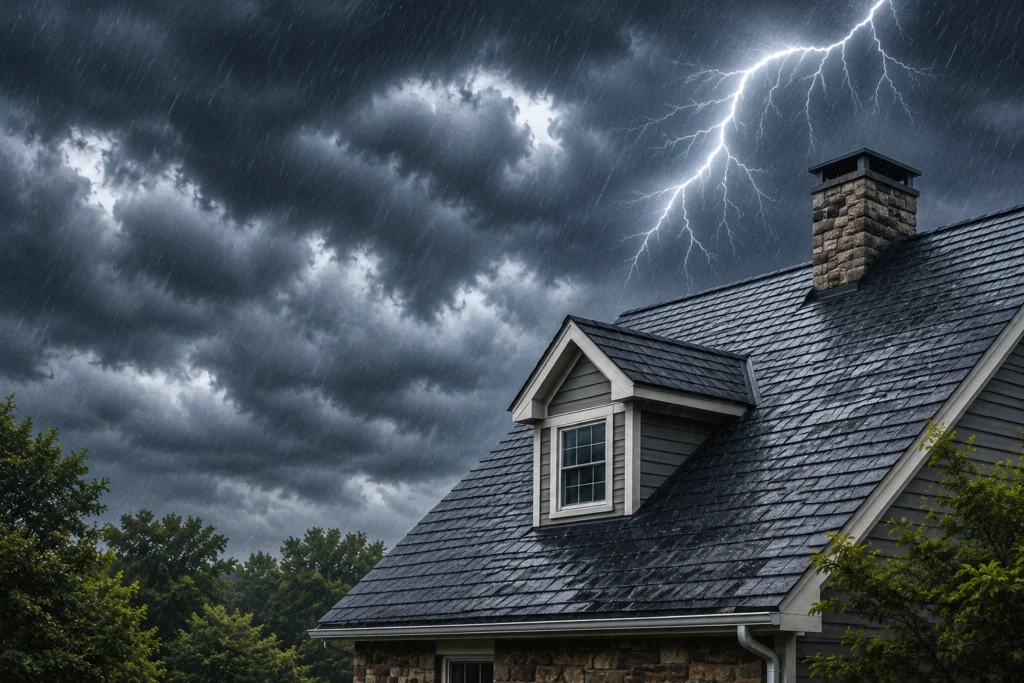
You watch the forecast. Another line of thunderstorms is rolling toward Bucks County this weekend, and you’re staring at the ceiling wondering if your roof is actually ready. Maybe you noticed a few shingles in the yard after the last Nor’easter. Maybe the gutters looked off the last time you checked. Or maybe you just have that nagging feeling — the one that says something isn’t right up there.
You’re not paranoid. Storm season in Pennsylvania is brutal on roofs, and most homeowners don’t realize how compromised theirs is until water is dripping through the dining room light fixture. Patching the obvious damage doesn’t fix the hidden problems. A roof can look perfectly fine from the driveway and still be one good storm away from a major leak.
This guide walks you through what storm damage actually looks like, what causes a roof to fail under pressure, and how a professional roof inspection in Bucks County catches the problems you can’t see from the ground. Over my 30 years in roofing, I’ve seen too many families get blindsided by a storm that didn’t have to be a disaster.
What You’ll Learn
- What storm damage to a roof really looks like (and why most of it is invisible)
- The real causes behind roofs failing during Bucks County storms
- How to identify warning signs before storm season hits
- Storm preparation steps every homeowner should take
- Why Bucks County homeowners choose Rylee Ann Roofing
- Frequently asked questions about roof inspections
- Next steps to protect your home
What Is a Storm-Damaged Roof?
A storm-damaged roof is one that has lost some part of its protective system — shingles, flashing, underlayment, sealant, or structural integrity — due to wind, hail, ice, falling debris, or sustained heavy rain. The damage isn’t always obvious. In fact, the most expensive roof failures usually come from damage that’s invisible from the ground.
Common storm damage signs include:
- Missing, cracked, curled, or lifted shingles
- Granule loss showing up in gutters and downspouts
- Dented or punctured metal flashing around chimneys and vents
- Lifted or torn drip edge along roof eaves
- Sagging spots or visible dips in the roofline
- Water stains on ceilings or in the attic
- Daylight visible through attic boards
- Damaged or detached gutters and downspouts
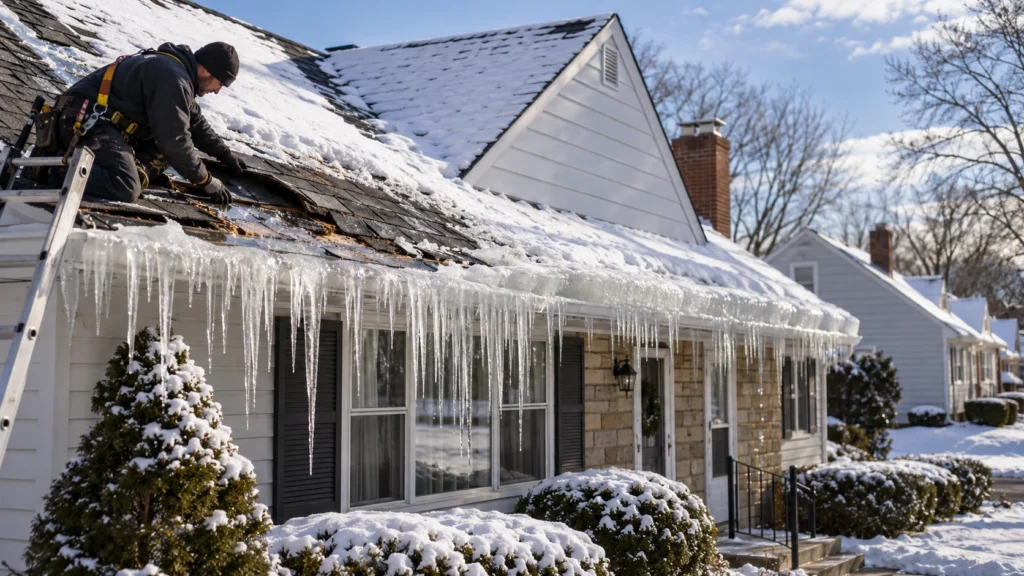
Bucks County homes get hit from every direction. Spring brings Nor’easters with sustained 40-60 mph winds. Summer brings sudden thunderstorms with hail and microbursts. Fall brings remnants of tropical systems pushing up the coast. Winter brings freeze-thaw cycles and ice dams. A roof doesn’t fail from one storm — it fails from the cumulative damage of dozens of them, often without anyone noticing until the leak shows up indoors.
The Real Causes Behind Storm-Damaged Roofs
Most homeowners think of storm damage as a single event — a tree falls, a section gets ripped off, you file a claim. But the roofs we inspect after major storms tell a different story. The damage that costs people the most is almost always the result of compounding factors that built up over time. Here’s what’s really going on.
Wind Uplift and Shingle Failure
Wind doesn’t tear shingles off in one clean swoop. It pries them up, breaks the adhesive seal between layers, and lets water work its way underneath. Once that seal is broken, the shingle looks fine from the driveway but is functionally useless. The next storm drives rain sideways under the lifted edge, soaking the underlayment and decking. By the time you see a stain on the ceiling, the damage extends well beyond that one spot.
Bucks County sits in a wind corridor between the Delaware River Valley and the Lehigh Valley, which means gusts from Nor’easters and summer storms hit hard and at unpredictable angles. Older shingles — anything past the 12-15 year mark — are especially vulnerable because the adhesive strips degrade with age and UV exposure.
Hail and Granule Loss
Hail doesn’t have to be golf-ball sized to wreck a roof. Even pea-sized hail driven by 50 mph winds knocks granules off asphalt shingles. Those granules are what protect the asphalt from UV damage. Once they’re gone, the shingle starts breaking down rapidly — sometimes failing years ahead of its rated lifespan. The damage often isn’t visible from the ground, but you’ll see the granules collecting in the gutters and at the bottom of downspouts.
Flashing Failure Around Penetrations
The most common leak point on any roof isn’t the shingles. It’s the flashing — the metal pieces sealing the connections around chimneys, skylights, vents, and where the roof meets walls. Storm winds work flashing loose. Hail dents and punctures it. Ice expansion in winter peels it back. When flashing fails, water has a direct path into the home, often running along the underside of the decking for several feet before dripping where you can see it.
Drainage and Gutter Damage
Storm winds and falling debris bend, pull, and detach gutters constantly. When gutters fail, water doesn’t drain off the roof properly. It backs up under the shingles, saturates the fascia and soffit, and rots out the wood framing along the eaves. In our 30 years serving Bucks County, gutter failure is one of the most overlooked causes of roof damage we encounter.
How to Identify Storm Damage Before It Costs You
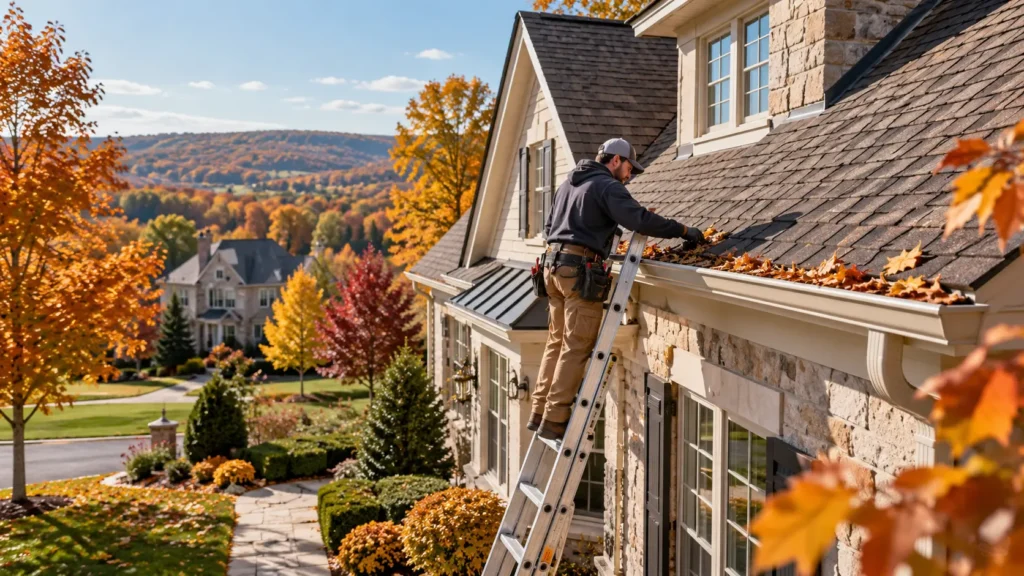
You don’t need to climb up on your roof to spot warning signs. In fact, please don’t — roof work isn’t safe for homeowners, especially after a storm when surfaces are slippery and structural integrity may be compromised. Here’s how to do a smart ground-level assessment:
- Walk the perimeter. Look at the ground around your house. Shingle pieces, granule piles near downspouts, or chunks of flashing in the yard all signal storm damage.
- Use binoculars. Scan the roof slope by slope. Look for missing shingles, dark patches where granules have washed away, lifted edges, or anything that looks out of place.
- Check the gutters. Bent sections, pulled-away brackets, or sagging spans mean wind got under them. Granules in the gutter trough or at the bottom of the downspout splash blocks confirm shingle wear.
- Inspect the attic. Go up with a flashlight on a sunny day. Look for daylight coming through where it shouldn’t, water stains on the underside of the decking, damp insulation, or musty smells.
- Look at ceilings and upper walls. Yellow or brown stains, bubbling paint, or peeling wallpaper near exterior walls often trace back to a roof issue.
If you spot any of these signs — or if a major storm has hit your area and you haven’t checked — schedule a professional storm damage roof inspection immediately. Insurance claims have deadlines, and damage gets worse fast once water has a path in.
Solution Options for Bucks County Homeowners
You have a few options depending on what you find and how severe it is. Here’s the honest breakdown.
When DIY Makes Sense
If you’ve cleared a few branches from the gutter or replaced a single shingle that blew off in a low-slope, easily accessible spot, that’s reasonable maintenance. Just understand the limits: you can’t safely inspect flashing, you can’t see what’s happening under the shingles, and you can’t assess decking integrity from the surface. A DIY look gives you a starting point, not a diagnosis.
What a Professional Storm Damage Roof Inspection Includes
A proper inspection from a roofing contractor in Bucks County covers the entire roofing system, not just the shingles. At Rylee Ann Roofing, every inspection includes:
- Visual assessment of all roof slopes, including hard-to-see areas
- Close inspection of flashing around chimneys, skylights, vents, and walls
- Evaluation of shingle condition, granule loss, and sealant integrity
- Gutter and downspout assessment
- Attic inspection for hidden leaks, ventilation issues, and decking condition
- Documentation with photos for your records (and for insurance claims if needed)
- A detailed Roofing Report Card showing exactly what’s in good shape, what needs attention, and what needs replacement
The inspection is free and there’s no obligation. If your roof is solid, we’ll tell you. If it needs work, we’ll show you exactly what and why with photo evidence.
Why Professional Roof Storm Preparation Pays Off
Most leaks we repair could have been prevented with a $0 inspection done before storm season. Catching a lifted shingle, a loose flashing piece, or a clogged gutter takes minutes to fix. Catching them after they let water into your home means drywall replacement, mold remediation, insulation replacement, and potentially structural repairs — often $5,000 to $20,000 or more. The math is simple. A 30-minute inspection now saves you from disaster later. Every Rylee Ann Roofing installation also comes backed by our 10-year leak-free workmanship warranty, well beyond the industry standard of 2-7 years.
Why Bucks County Homeowners Choose Rylee Ann Roofing
We’ve been protecting homes in Bucks County since 2016, and our team brings 30 years of industry experience to every roof we touch. We’re a family-owned roofing contractor, not a multifaceted construction company — roofing is all we do, and we do it with factory-trained, Owens Corning Certified crews on every job.
What sets us apart for Bucks County homeowners:
- Owner onsite every job. Steve Nickerson personally oversees every project, from the first inspection to the final cleanup. You’re not handed off to a rotating crew of strangers.
- 10-year leak-free workmanship warranty. While most contractors offer 2-7 years, we stand behind our work for a decade.
- 24-hour issue resolution policy. If anything comes up during or after your project, we address it within 24 hours.
- Licensed in PA (HIC #139247) and NJ (HIC #13VH10032900). Fully insured, fully legitimate.
- Local roots, local trust. 5-star Google rating with 50+ reviews, Nextdoor Neighborhood Favorite (2022), and proud community partner with the Levittown-Fairless Rescue Squad, Tullytown Fire Company, Bristol Borough Hall, and Edgeley Fire Co.
We serve homeowners across Fairless Hills, Levittown, Yardley, Newtown, Langhorne, Bristol, Tullytown, Falls Township, Morrisville, and Croydon, plus Lehigh County PA, Mercer County NJ, and Burlington County NJ.
Frequently Asked Questions
How much does a roof inspection cost in Bucks County PA?
A roof inspection from Rylee Ann Roofing is completely free with no obligation. Our Roofing Report Card includes a full assessment of your roof system, photo documentation, and a clear breakdown of any issues. We provide this at no cost because we want Bucks County homeowners to know exactly where their roof stands.
How long does a roof inspection take?
Most residential roof inspections take 30 to 60 minutes, depending on the size and complexity of the roof. We do not rush. Steve Nickerson personally inspects the roof, flashing, gutters, and attic to give you a complete picture of your roofing system’s condition.
When should I get a roof inspection before storm season?
Schedule your inspection in early spring (March-April) before peak Nor’easter and thunderstorm activity, or in late summer (August-September) before fall storm season. Inspecting after a major storm is also smart, especially if you’ve seen debris in your yard or noticed any leaks.
Will my insurance cover storm damage repairs?
Most homeowner’s insurance policies cover sudden storm damage from wind, hail, and falling debris. Wear-and-tear from age is generally not covered. We provide detailed photo documentation with every inspection, which makes filing a claim significantly easier. Insurance claims also have deadlines, so don’t wait.
Can I inspect my own roof safely?
We strongly recommend staying on the ground. You can do a thorough visual assessment from the perimeter, from inside the attic, and using binoculars. Roof surfaces are slippery, fall risks are real, and storm-damaged decking can fail unexpectedly. Let a professional with the right safety equipment do the close-up work.
What’s the difference between a regular inspection and a storm damage inspection?
A storm damage roof inspection focuses specifically on identifying damage caused by a recent weather event — wind uplift, hail impacts, debris strikes, and water intrusion. It’s typically used to support an insurance claim. A regular inspection is broader, covering overall roof condition and remaining lifespan. We perform both.
Do you serve commercial properties too?
Yes. Rylee Ann Roofing handles commercial roof inspections, repairs, and replacements across Bucks County and the surrounding region. We work with TPO, EPDM, modified bitumen, metal, acrylic coating, and silicone roof systems.
Next Steps
Storm season won’t wait. Here’s what to do right now:
- If you’ve already had storm damage, call us today at 833-691-7663. Insurance claim deadlines move fast.
- If you haven’t had an inspection in over a year, schedule your free Roofing Report Card before the next storm hits.
- If you’re not sure where to start, call us and we’ll walk you through it. No pressure, no obligation.
You can reach Rylee Ann Roofing at 833-691-7663 or request a free estimate online. We respond within 24 hours and serve Bucks County PA, Lehigh County PA, Mercer County NJ, and Burlington County NJ.
Hours: Monday-Friday 7am-5pm, Saturday 7am-12pm
About the Author
Steve Nickerson is the Estimator and Principal at Rylee Ann Roofing in Fairless Hills, PA. With 30 years of hands-on experience in residential and commercial roofing, Steve personally inspects every job and oversees every project from start to finish. He is an Owens Corning Certified Installer, licensed in Pennsylvania (HIC #139247) and New Jersey (HIC #13VH10032900), and has built Rylee Ann Roofing on a foundation of straightforward communication, quality workmanship, and a 10-year leak-free warranty that’s well above industry standard.